Who We Are
Phase Two Music is the result of a lifelong intersection between music and engineering.
I’ve been making music for over 40 years, primarily as a guitarist on both acoustic and electric instruments, including steel- and nylon-string guitars. Over the years I’ve played in a wide range of bands and settings—progressive rock, jam bands, classic rock, folk, and 1960s–70s cover projects. While guitar has always been my primary voice, I’ve also spent time on keyboards and bass, which has shaped how I think about arrangement and sound from a broader musical perspective.
My interests in music extend beyond performance. I’ve always been drawn to music theory and harmony, recording and production techniques, sound creation, and the history and evolution of recorded music. Understanding why something sounds the way it does has always been as compelling to me as playing it.
In parallel with music, I spent roughly four decades as an analog circuit design engineer in the aerospace industry. Over the course of my career, I progressed from hands-on circuit designer to design manager, electrical discipline chief, and ultimately the company’s Electronics Discipline Lead and Principal Fellow. Career highlights include more than two dozen patents, several peer-reviewed technical papers, and service on the executive board of an industry consortium.
Throughout my career, I’ve consistently looked for ways to bring these two worlds together. That has included engineering and producing a band album, building guitars and basses with my son, repairing and modifying musical instruments, creating sample libraries and scripting tools for personal use, developing custom audio tools and ensembles, and designing guitar effects—both from kits and from original circuits.
Phase Two Music exists as a continuation of that work: applying a deep engineering mindset to musical tools, with an emphasis on clarity, intent, and understanding—not just results.
Design Philosophy and Process
Every Phase Two Music design begins with the same principles that guided my career in aerospace electronics: clarity, verification, and intent.
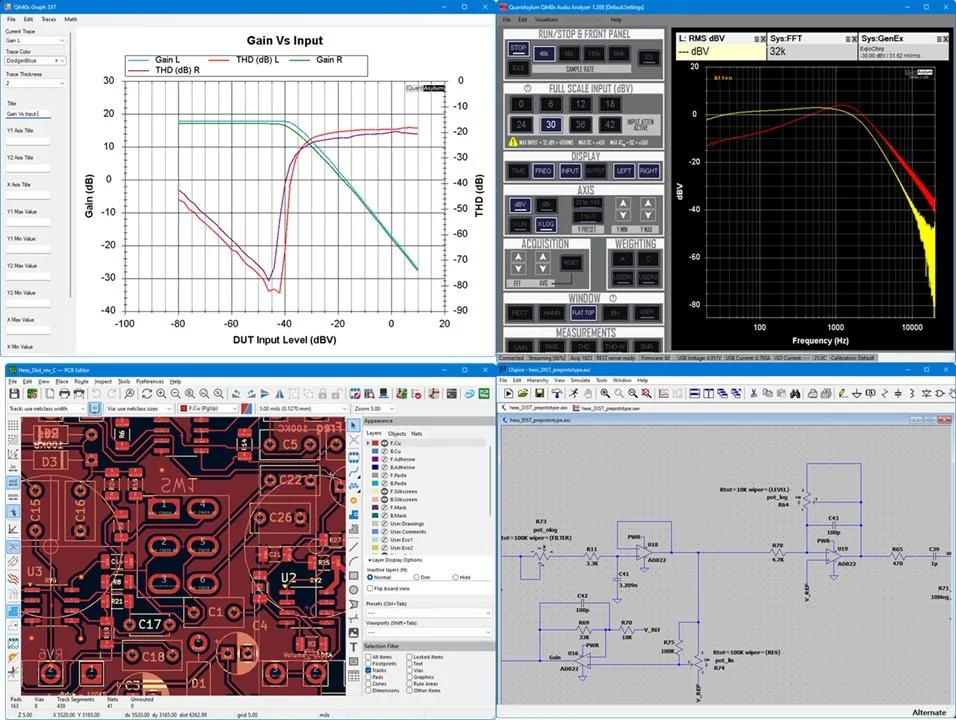
The circuit design process is grounded in best practices developed over four decades of professional analog electronics work. Designs are extensively simulated and then validated against physical hardware. Beyond basic frequency-response analysis, circuits are modeled and verified for non-linear behavior, including saturation and clipping characteristics, to ensure that real-world performance matches the design intent.
Manufacturing choices are made with equal care. Component selection deliberately combines surface-mount and through-hole parts, using each where it offers the greatest electrical or mechanical advantage. The layouts are designed so that component values can be identified and verified through visual inspection, reinforcing transparency and serviceability.
Quality control is both systematic and personal. Each pedal undergoes a combination of automated and manual testing, followed by real-world evaluation. Every unit is personally played and listened to before it leaves the shop—not as a formality, but as the final verification step that measurements alone cannot replace.
Phase Two Music pedals are not designed to obscure or mystify sound. They are built to be understood—technically, musically, and sonically—so that the player can focus on expression rather than uncertainty.